
Sequence plan 1917 (2019)
Director: Sam Mendes
Year : 2019
Director: Sam Mendes
Country: United Kingdom / United States
Director of Photography: Roger Deakins (ASC, BSC)
Steadicam/camera operators: Peter Cavaciuti, Charlie Rizek
Editor: Lee Smith
Production Designer: Dennis Gassner
Camera: ARRI Alexa Mini LF (3 prototype units)
Shot duration: 119 minutes (entire film, ~30 shots assembled)
Longest take: ~8 min 30 sec
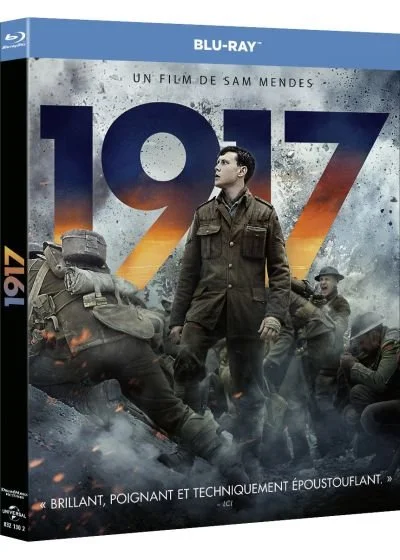
Two British soldiers, Schofield (George MacKay) and Blake (Dean-Charles Chapman), are awakened under a tree. An officer gives them an order: cross no man's land, the abandoned German lines, the devastated French countryside, and reach a battalion preparing to launch an assault. The message they carry must stop the attack. 1,600 men will die if the two soldiers don't arrive in time. From that moment on, the camera never leaves them. Not a single cut in 119 minutes. You walk with them, you crawl with them, you run with them. And you can't look away.
Why this scene is iconic
Talking about "scenes" is meaningless; the entire film is conceived as a single, continuous shot in real time. Mendes made this choice for a simple reason: the mission of these two soldiers is a race against time, and any cut would have offered the viewer an escape route the characters don't have. By refusing to cut, Mendes denies you the right to catch your breath. Every meter of ground covered is a meter you cover as well. When they crawl over dead horses, you crawl. When they swim through a river full of corpses, you swim. The exhaustion you feel at the end of the film isn't metaphorical; it's physical. The real-time format transforms a war film into a shared test of endurance.
How they filmed it
The film is composed of approximately 30 shots assembled using invisible cuts, which Deakins calls "blends" in his Blu-ray commentary. The longest take lasted about 8 minutes and 30 seconds. The cuts are masked by passages in shadow, abrupt movements, crossings of dark spaces, or narrative fades to black. The most audacious is a fifteen-second black screen when Schofield loses consciousness: when the image returns, it is morning. The character taps his watch; it has stopped. Mendes signals to the viewer that time has jumped, while maintaining the illusion of a continuous shot.
The preparation lasted nine months. Dennis Gassnerbuilt models of each set so that Mendes and Deakins could choreograph the camera and actors' movements in advance. Every trench, every street, every field had to be exactly the length of the scene; the length of the dialogue determined the physical distance of the set. Before the sets were built, the crew drove stakes into a farm field to mark the trenches and rehearsed with the actors for four months.
Deakins used three prototypes of the ARRI Alexa Mini LF, a large-format camera light enough to be mounted on a stabilizer. Four stabilization systems were tested and selected: the classic Steadicam, the ARRI Trinity (hybrid mechanical/electronic stabilization), the Stabileye (a remote-controlled head with electronic stabilization, used for more than half the film), and a remote-controlled Mini Libra head for the cranes. The team also invented a specific device: a "gyro post" for Peter Cavaciuti, the Steadicam operator, which allowed him to run forward through the trenches with the camera facing backward, filming the actors from the front while he ran with his back to them.
The cameras were mounted and dismounted using cables, 50-foot Technocrane cranes, motorcycles, 4x4s, and even a drone over water. Cavaciuti and Rizek fell into the trenches several times. There was only one spare camera.
The most technically complex scene is Schofield's final run across the battlefield. Deakins describes it with a smile: "The camera comes down from a 50-foot Technocrane, is carried by hand up the hill backwards, then placed on another Technocrane mounted on a truck that takes off at full speed. And the grips who carried the camera are in soldiers' uniforms; they were paid as extras."
The takes averaged 20 attempts per sequence. The most difficult required 50. Mendes described the pressure: "You get to seven minutes from the take, and someone trips, or mud lands on the lens, or a pyrotechnic effect fails. The game can be perfect and everything else can go wrong. And you start again."
Deakins often operated the camera remotely from a van, using a monitor. Lee Smith, the editor, edited in near real-time during filming; the previous take had to be perfectly matched before Mendes would agree to repeat the next one. Smith summed up the experience: "It was like standing there completely naked. All my usual armor had been taken away."
Outdoor lighting presented a continuity problem: natural light is constantly changing. The crew rehearsed scenes at the same time of day to ensure consistency. For night scenes, massive rigs simulated the flashes of flares and gunfire.
What to observe when reviewing it
The day/night transition (~1 hour): Schofield is knocked unconscious. The screen remains black for fifteen seconds. When the image returns, it's daytime. Look at his hand: he's tapping his watch. It has stopped. It's Mendes who tells you that time has jumped ahead, the only deliberate ellipsis in the film.
The final run across the battlefield (~1h45) Look for the camera operators disguised as soldiers. They just carried the camera while running and stayed within the frame. You probably won't be able to see them; that's the point.
The no man's land (~20 min) The camera constantly changes its relationship with the characters: in front, behind, beside, in close-up, in wide shot. Deakins said that this sequence defined the visual language of the rest of the film, the answer to the problem "how to film dialogue without shot-reverse-shot".
Did you know that?
The story is inspired by the accounts of Mendes' grandfather, Alfred Mendes, who served as a messenger during the First World War. He was chosen for this mission because he was too small to be seen above the fog of no man's land. Mendes also recounted that his grandfather retained a lifelong habit: compulsively washing his hands to remove the mud from the trenches. This gesture became, for the director, a symbol of the physical scars left by war on the body.
When Deakins read the script with the instruction "one shot" on the first page, he thought it was a typo. Lee Smith, the editor, burst out laughing. When Mendes was asked how he chose where to hide the cuts, he replied, "What cuts?" The film grossed $385 million on a budget of $90 million, won the Golden Globe for Best Drama, and earned Deakins his second Oscar for cinematography.
Sources
Roger Deakins, interview The Hollywood Reporter (January 2020)
Sam Mendes & Roger Deakins, CNN Style interview - "'1917': Inside the making of a one-shot masterpiece" (December 2019)
No Film School - "Watch How Roger Deakins Shot 1917 All In One Take" (2019)
No Film School - "How 1917 Pulled Off the Illusion of a One-Take War Epic" (2025)
Offscreen - "1917: The 'Hard Work' of the Digital Long Take" (2022)
Filmmakers Academy - "The Look of 1917"
StudioBinder - "1917 One Shot Explained"
Screen Rant - "1917: Every Kind of Shot Used"
CineD - "Inside the Look of 1917 by DP Roger Deakins"
The Conversation - "Sam Mendes' 1917 - and five other films that really are continuous single takes"
Vanity Fair - Making of 1917 (behind the scenes exclusive)
Also read:
The Long Shot of Adolescence (2025) https://www.plan-sequences.com/categories-de-plans-sequences/adolescence - The Netflix series that pushed the constraint of the continuous shot for an entire episode to its limit, six years after 1917
Why the Length of a Long Take Changes Everything https://www.plan-sequences.com/blog-plan-sequences/pourquoi-la-dure-d-un-plan-sequence-change-tout - What 119 uncut minutes do to the viewer's brain, and why physical fatigue is a narrative intention
Watch the film & go further
Watch the film:
Recommended reading:
- Those of 1914 - Maurice Genevoix
The film was inspired by the testimony of Sam Mendes' grandfather, a messenger during the First World War. This account by Genevoix, who experienced the Marne and then Les Éparges, tells of the same war, the same mud, the same fear that the film recreates on screen, a classic French trench warfare testimony.
The links to Amazon are affiliate links: your purchase supports plan-sequences.com at no extra cost to you.
